Rulebook
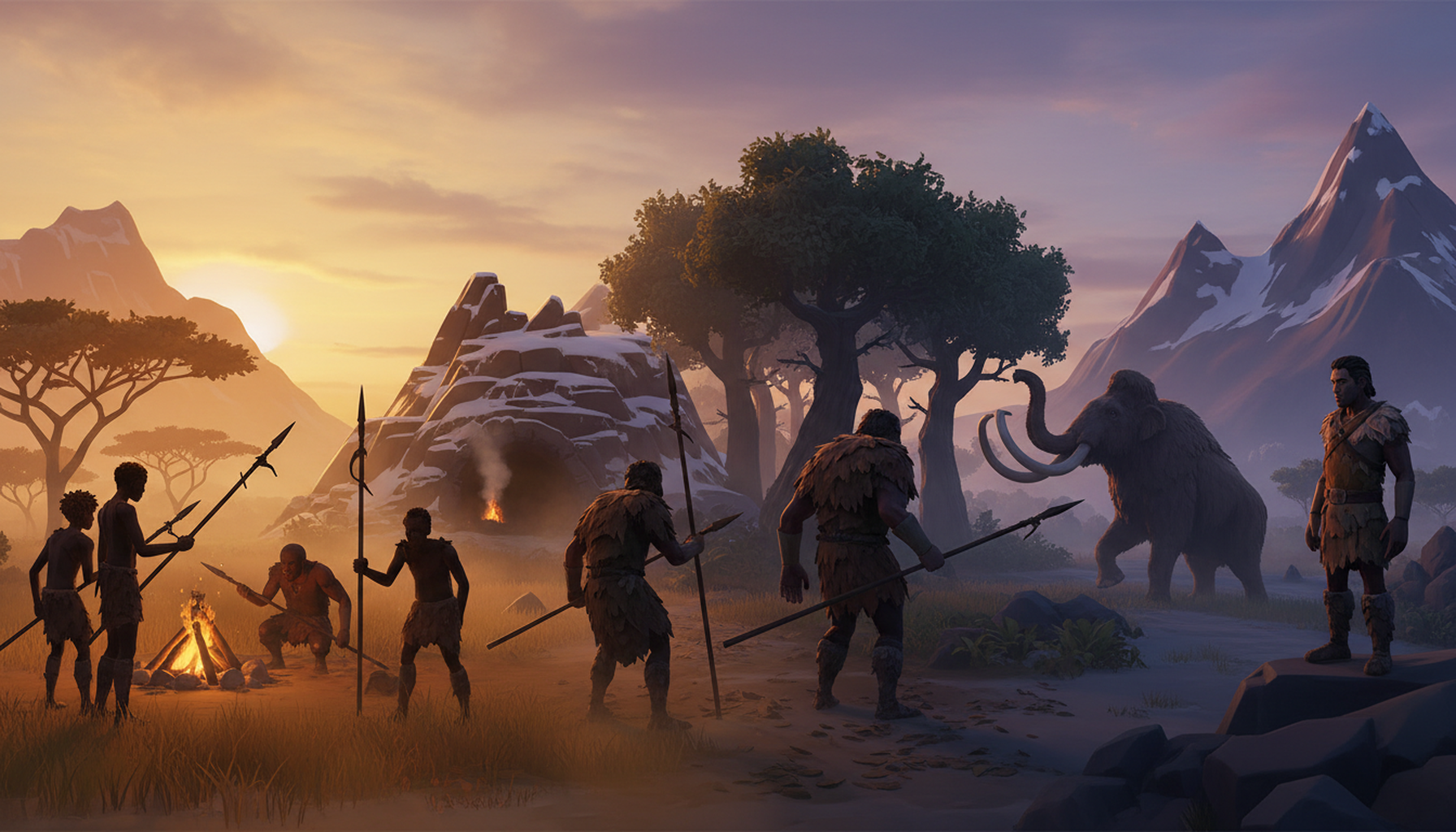
Table of Contents
Core Rules
Gameplay
Card Reference
Combat & Victory
Introduction
It is roughly 70,000 years ago. The Late Pleistocene is in full grip, and the climate lurches between warming spells and frigid cycles. Across Eurasia, the great megafauna herds that once fed thousands — woolly mammoths, straight-tusked elephants, giant rhinoceroses — are failing. The herds dwindle with each passing generation. Competition for dwindling prey grows desperate and bloody.
Four species of the genus Homo now clash directly for survival. Homo sapiens — anatomically modern humans from Africa — sweep northward and eastward with revolutionary blade technology, superior hunting tactics, and tight-knit trade networks. They are fast, adaptive, and ruthless. Homo neanderthalensis — the Neanderthals — have dominated Ice-Age Europe for a hundred thousand years with their powerful builds, deep cave strongholds, and mastery of thick hides. But their ranges shrink as Sapiens encroach, and their populations fragment into besieged enclaves. Homo heidelbergensis and their descendants still persist in remote refugia — wielding massive wooden spears and guarding the last strongholds of the old megafauna hunts. And in the mountains and caves of East and Central Asia, the enigmatic Denisovans (Homo longi) defend their ancient territories against all invaders, from the frozen peaks of Tibet to the forests of Southeast Asia.
The world is shrinking. Resources are scarce. The age of coexistence is over.
In Shared Worlds you lead one or two of these tribes — the Sapiens, the Neanders, the Heidels, or the Denisovas — in a desperate bid for dominance across a dying world. Build an economy, raise a warband, and eliminate your rivals. Only one species will inherit the future.
Overview
The game plays 2–4 players:
- 2–3 Players: Free-for-all — each player competes individually
- 4 Players: Team mode — 2v2 with shared victory
Cube Overview
The game uses only two physical cube colors:
| Color | Represents | Notes |
|---|---|---|
| ⬛Black | Resources / Power | The building a cube sits on determines its type (Fire / Leather / Wood / Stone). On units, black cubes represent power (attack strength). |
| 🔵Blue | Life | Used exclusively for unit life (funded from general supply). Player life is tracked separately with a Life-tracker device. |
Tribes
| Tribe | Primary Resource | Playstyle |
|---|---|---|
| 🏹Sapiens | Fire | Development |
| 🦴Neanders | Leather | Defense |
| 🔥Heidels | Wood | Attack |
| 🗻Denisovas | Stone | Diplomatic |
Tribe Lore
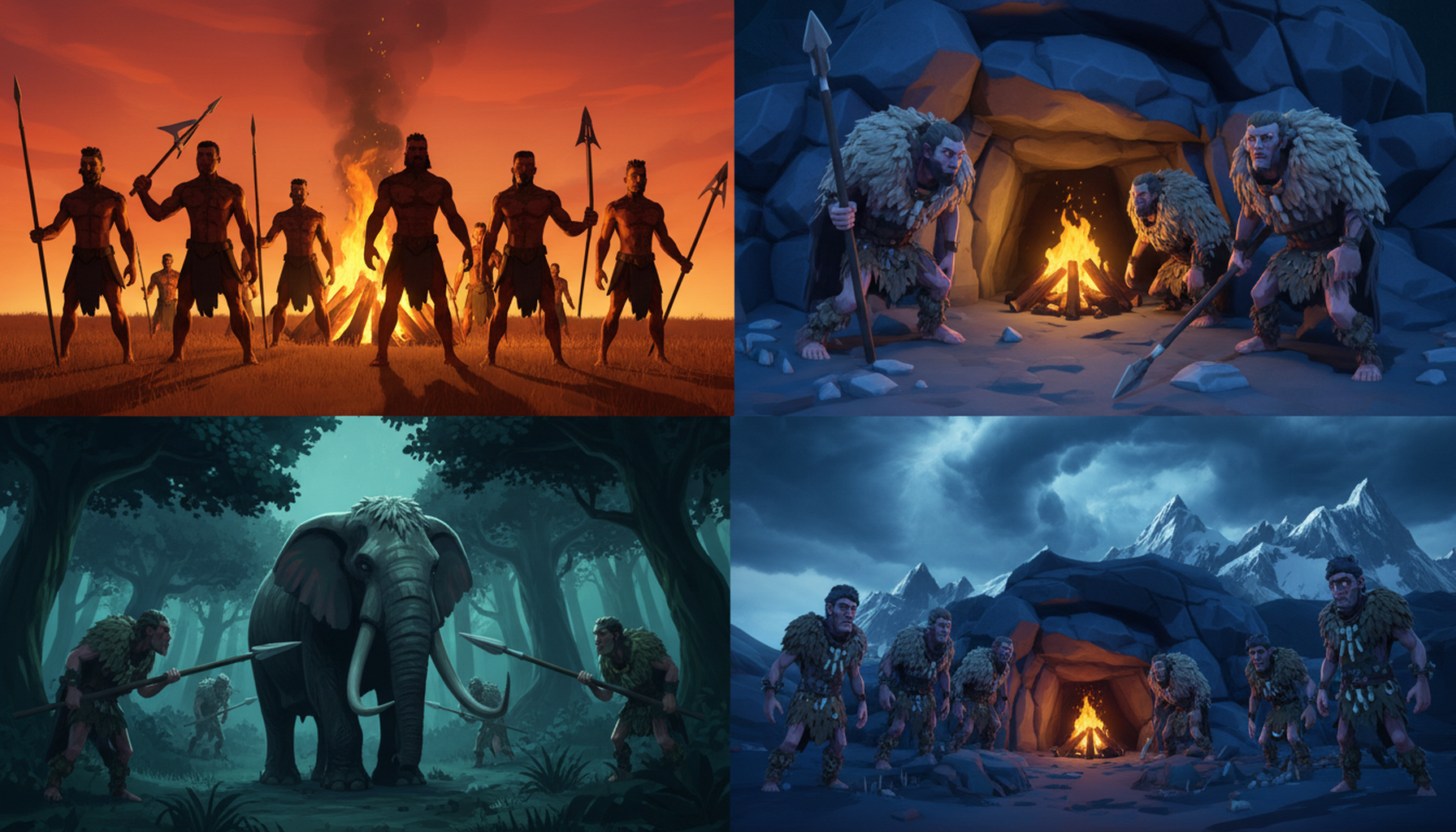
The following descriptions provide the historical and thematic basis for each tribe. Card names, abilities, and art should reflect these characteristics.
Faces and skin: every character's face and skin must relate to the geographic origin of their tribe, so the four tribes stay visually distinct on the table — Sapiens from Africa, Neanders from Ice-Age Europe and Western/Central Asia, Heidels from Europe/Africa/West Asia, Denisovas from Siberia, the Tibetan Plateau and East/Southeast Asia.
🏹 Homo Sapiens — the Sapiens
Era: ~70,000 years ago – present | Range: Originated in Africa, rapidly expanding into Europe, Asia, and beyond
Appearance: African origin — brown skin ranging from deep umber to lighter tan, tightly coiled or woolly hair, high rounded forehead, narrow projecting nose, full lips, and a well-defined chin.
Anatomically modern humans are the most innovative and socially connected of the four species. Having recently begun their migration northward and eastward out of Africa, Sapiens are distinguished by their advanced fire mastery and tool-crafting — producing controlled flame, thin symmetrical blades, and microliths — as well as long-distance trade networks, complex language, and emerging symbolic art (cave paintings, carved figurines, shell beads).
Sapiens hunted with thrown projectiles (atlatls), enabling precision strikes from a distance. Their social groups were large and highly organised, with clear division of labour. They accumulated wealth and status goods in unprecedented quantities and managed resources with ruthless efficiency. Their adaptability and organization let them continually improve their tools, plans, and supply networks—turning small advantages into a durable engine for growth.
In-game identity: Development — building an efficient engine over time. Sapiens improve their resources and hand, refine their Deck by removing cards, and use planning and preparation to make later turns more effective. Their development abilities reward investing in their own long-term growth rather than disrupting an opponent directly.

🦴 Homo neanderthalensis — the Neanders
Era: ~400,000 – 35,000 years ago | Range: Europe, Western & Central Asia; range fragmenting as Sapiens encroach
Appearance: Ice-Age Eurasian origin — pale to ruddy, freckled skin, mid-face projection with a broad, powerful nose, low sloping forehead, a receding chin, and fair, reddish-brown or light-brown hair.
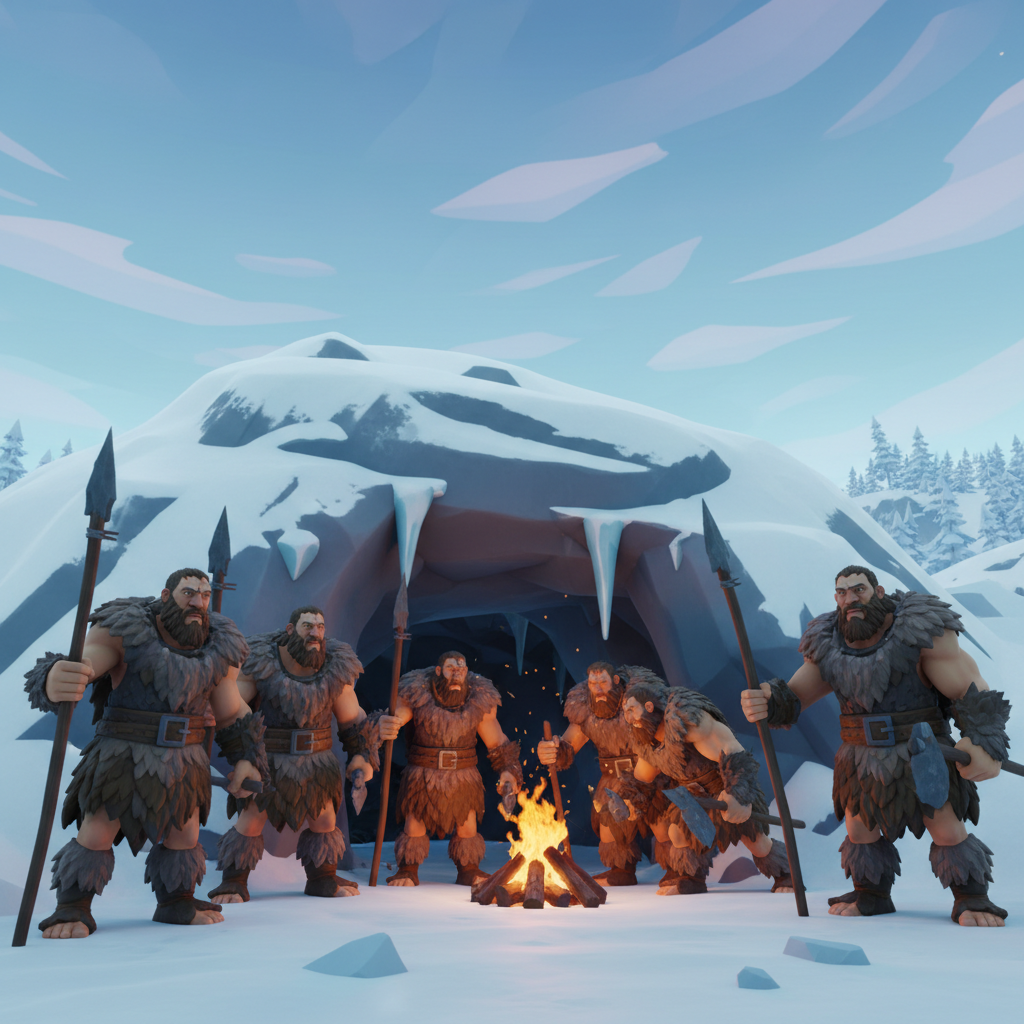
Neanderthals were stocky, powerfully built humans adapted to the harsh glacial climates of Ice-Age Europe. They had larger brains (on average) than modern humans, short robust limbs (an adaptation to conserve heat), and immense physical strength — they were effective sprinters with more fast-twitch muscle fibres.
Neanderthals were apex predators who hunted large game (bison, aurochs, red deer, even straight-tusked elephants) at close range with thrusting spears. They were master leather-workers, using stone scrapers to process animal leather into crude cloaks and blankets. They lived in tight-knit bands of 10–30 individuals, often in caves they defended fiercely for generations, and they buried their dead — sometimes with flowers and grave goods. Their strongholds were nearly impregnable; few predators dared challenge them in their fortified lairs.
They invented birch-bark tar (the earliest known adhesive) and used fire extensively for warmth, cooking, and tool-hardening. Now, however, their world shrinks. Sapiens invaders press from the south and east; megafauna herds dwindle; their once-vast territories fracture into isolated strongholds. Yet the Neanders endure, stubborn and resilient.
In-game identity: Defense — building defensive positions, maximizing (unit) life, and dominating through resilience and fortification.
🔥 Homo heidelbergensis — the Heidels
Era: ~700,000 – 70,000 years ago | Range: Europe, Africa, West Asia; now retreating to isolated refugia
Appearance: Wide-ranging Middle Pleistocene origin across Europe, Africa and West Asia — tall and massively built, with a prominent continuous brow ridge, a large jaw lacking a chin, a broad projecting nose, and skin tones spanning the sun-exposed savannas to the glacial north.
Homo heidelbergensis is widely regarded as the ancestor of Neanderthals and Denisovans. They were tall (165–181 cm) and powerfully built, with massive brow ridges and large jaws lacking a chin.
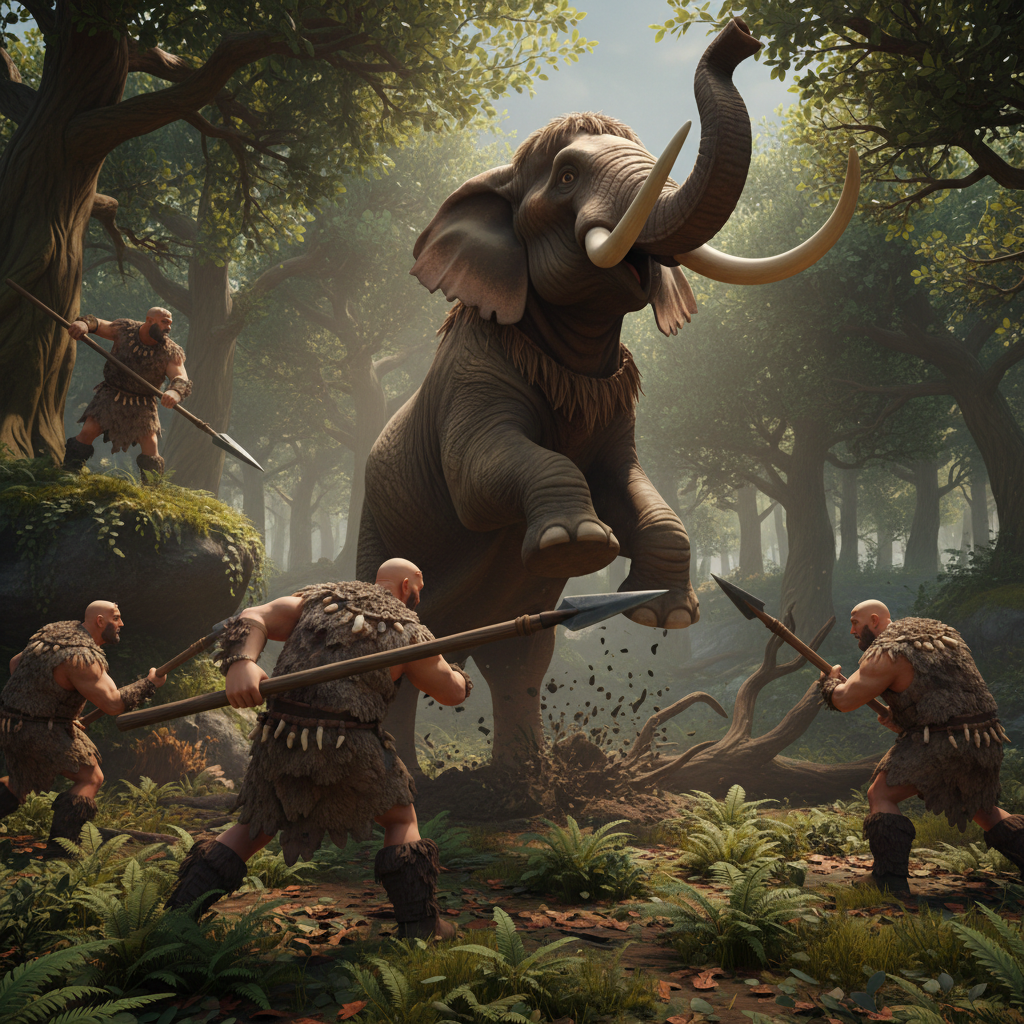
Heidelbergensis were the first humans to routinely hunt megafauna — straight-tusked elephants, rhinoceroses, and aurochs — using heavy wooden spears (such as the 300,000-year-old Schöningen spears made from selected wood like European yew). They relied on overwhelming force and coordinated numbers to bring down prey no individual could defeat. They built the earliest known shelters — stone-foundation huts with vaulted branch roofs — and were among the first to use fire regularly in Europe. Their Late Acheulean hand axes were refined tools of devastating lethality.
Yet their world is disappearing. The megafauna herds that sustained them for millennia are collapsing. Younger species with new tactics and superior numbers crowd them from all sides. The Heidels are a dying breed, clinging to the last refugia where the old hunts still echo.
In-game identity: Attack — raw aggressive power, overwhelming force, and dominance through sheer martial strength.
🗻 Homo longi (Denisovans) — the Denisovas
Era: ~300,000 – 30,000 years ago | Range: Siberia, Tibet, East & Southeast Asia; now under increasing pressure from Sapiens expansion
Appearance: East and Central Asian origin — faces broadly similar to modern humans, but with thick brow ridges, no tall forehead, and robust jaws; straight dark hair, high cheekbones and eye folds suited to the steppe, and skin ranging from the light complexions of Siberia and the sun-scorched Tibetan Plateau to deeper tones in the subtropical forests of the south.
The Denisovans have thrived in extreme environments for hundreds of thousands of years — from the frigid Denisova Cave in Siberia to the Tibetan Plateau (Baishiya Karst Cave at 3,200 m, with evidence reaching ~3,700 m) and the subtropical forests of Laos and southern China. Recent skeletal analysis reveals faces broadly similar to modern humans, but with thick brow ridges and robust jaws, suggesting a unique branch of humanity.
Denisovans were highly adaptable across varied environments, from high plateaus to forested lowlands. Their material culture and survival in marginal lands speak to ingenuity and flexibility. They made cave shelters, worked stone and bone, and adorned themselves with elaborate jewellery. At least three genetically distinct Denisovan populations existed, suggesting remarkable adaptability across different regions. In the game, that flexibility is expressed through diplomacy: Denisovas bargain with rivals, lend resources, offer cards in exchange for agreements, and protect threatened units. These are game-theme interpretations of their adaptability, not claims about specific historical diplomatic practices.
Yet now Sapiens invaders, with their superior numbers and technology, push eastward and upward, challenging Denisovan dominance of their ancient territories. The mountains and caves that once seemed impregnable are becoming battlegrounds.
In-game identity: Diplomatic — turn negotiation into a strategic tool. Denisovas can offer resources or cards to make deals, secure temporary protection, and influence opponents' choices. Their diplomacy is pragmatic rather than pacifist: they still defend their territory and can use force, but often seek advantage through bargains and leverage instead of relying only on direct attacks.

The Playing Field
Setup
-
Put the reference cards and the 8 buildings aside
-
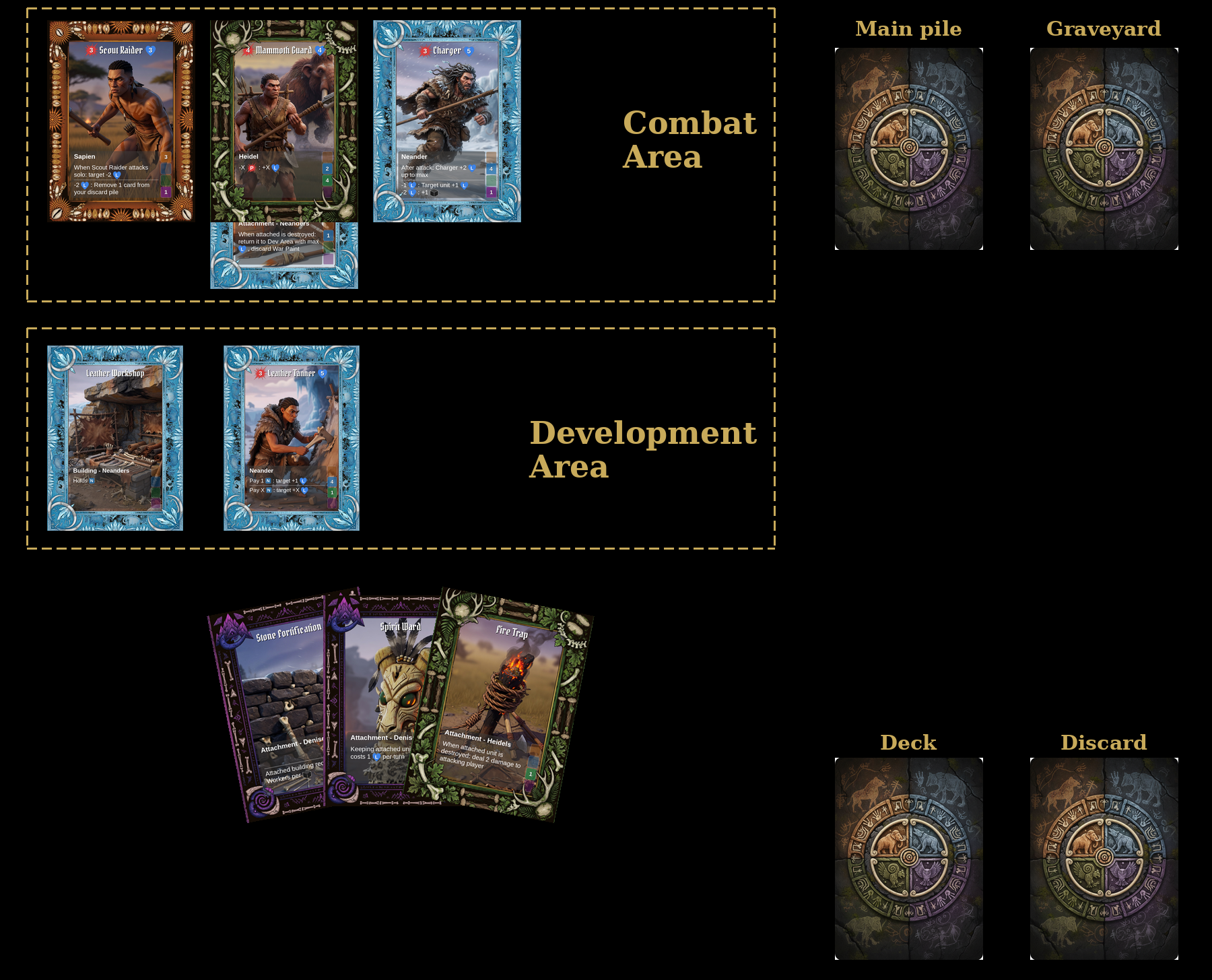
Shuffle all remaining cards into the Main Pile, and place it at the outer edge of the playing field. Place the first card from the main pile face-down besides it to indicate the Graveyard. In a 2-player game, this layout places each player's Combat Area directly in front of the opponent.
-
Every player selects 1 (4P) or 2 (2P/3P) factions and takes 1 building for each selected faction. The buildings are placed in their Development Area
2P/3P Selection: In a 2-player game, P1 picks a faction A (gets 1 building). Then P2 picks a faction (gets 1 building). Then P1 picks a second faction B (gets 1 more building). Then P2 picks a second faction (gets 1 more building). Each player now has 2 buildings total. In a 4-player game, each player picks 1 faction only and gets 1 building.
-
Each player takes 2 black resource cubes from general supply and divide them evenly over their buildings. Note that each player obtains an additional (third) resource in the first round (see Phase Sequence).
-
Each player takes a Life-tracker device and sets it to 20. This device tracks the player's personal life total.
-
The blue Life cubes are used to supply life to units (typically when a unit is played) and are placed on the opposite side of the main pile.
Turn Structure
Turn Order
Free-for-All (2–3 Players): Sequential — P1 → P2 → (P3) → repeat
Team Mode (4 Players): Alternating — P1 → P3 → P2 → P4 → repeat
Phase Sequence
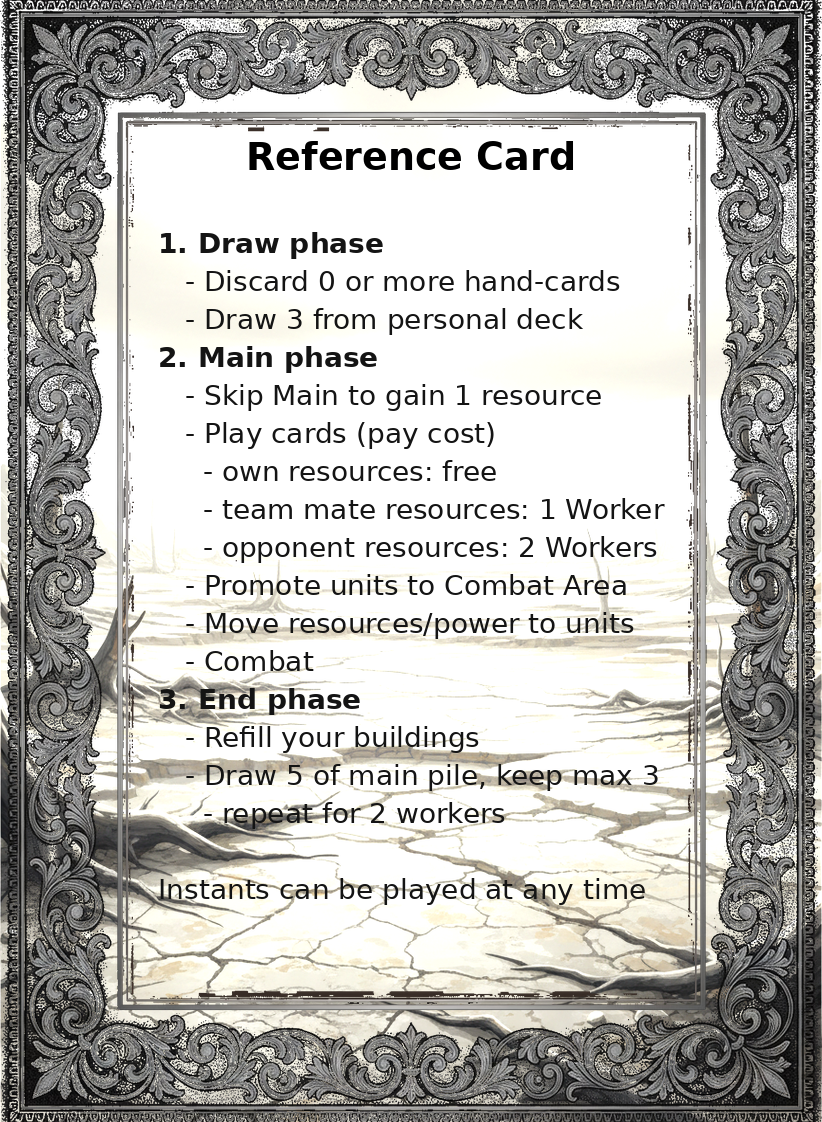
Each turn has three phases, in order shown below. All actions listed in following sections are optional unless stated differently. You can play instants from your hand at any time (on any player's turn), but instants still cost resources to play (unless an ability states differently).
Note: The first round players have no (zero) hand-cards until they draw their very first ones in their End Phase. Therefore, the first Draw Phase and Main Phase are always skipped. For that reason, the active player always obtains an additional resource in the first round.
1. Draw Phase
- Choose which cards in your hand to keep. The rest go to your Discard pile.
- Draw up to max(0, 3 + active Hand cards +X bonuses - cards kept). If your Deck is empty when you need to draw, shuffle your Discard pile into your Deck first, then draw from it.
- Your hand limit for this phase is 3 cards plus any active Hand cards +X bonuses. These bonuses apply to the draw amount and hand limit only while their source card is in your Development Area.
2. Main Phase
Skip Main Phase and place 1 additional resource from the general resource pool onto one of your buildings or:
- Play cards from hand into a 'lane' (pay full cost)
- Promote (move) units from your Development Area to your Combat Area
- Move resources from your buildings to your units. Each time you click Charge, move exactly one resource; it becomes one Power for that unit. A unit cannot contain more Power than its printed Power value. You may charge units before or after combat; after an attack resolves, spent Power returns to your buildings and can be used to charge again during the same Main Phase. Any remaining Power stays on the attacker. An attacking unit is tapped and cannot attack again that turn.
- Combat
- Declare attackers. Defending player may intercept unblocked attackers with a free Combat Area unit or a Development Area unit (see Interception). Declare blockers (lane-based).
- Resolve simultaneous damage (Power cubes). Power cubes from blocking or intercepting units are spent until their owner's next End Phase. An unblocked attacker spends all its Power. An attacker that fights a unit spends Power cubes equal to the defending unit's Life before damage, up to the attacker's Power; any remaining Power stays on the attacker. Excess attack damage still applies to the defending player's Life as described in Combat.
3. End Phase
- Mandatory: First divide all used resources evenly between your buildings, rounding down. If one resource remains, choose the building that receives it after the even portion has been returned.
- Draw 5 cards from the main pile . Choose up to 3 of them and keep them face-down on top of your Discard pile; the remaining cards go to the graveyard. These actions can be repeated by removing 2 worker cards from your building, see Building Refill / Obtaining Workers.
The Development Area
Each player has their own Development Area where their development cards reside. The Development Area is the row below the Combat Area. The Development Area holds:
- Buildings — produce resources and auto-refill at End Phase (see Resources).
- Units and attachments — face-up cards that stay across turns. Units in the Development Area cannot be attacked, and cannot attack or block.
Cards are played from hand into the Development Area (not the Combat Area). Cards can be moved from the Development Area to the Combat Area but they can never return (unless an ability states differently).
Units in the Development Area are placed in specific lanes: left, center, or right. These lanes correspond to the lanes in the Combat Area. A unit's lane is determined when it is played and cannot be changed unless a card ability states differently. A unit card cannot be played into a Development Area lane that already contains one of that player's cards, whether that card is in the Development Area or the Combat Area. A player may have only one unit in each lane across both areas. When the opponent has more units in their Combat Area than the active player, a newly played unit must be placed in a lane occupied by one of those opponent Combat Area units. This lane system ensures that units can only be targeted by attacks and abilities from the corresponding lane in the Combat Area.
Resources
Resources are kept by your buildings. They can be used to:
- play cards from hand (units, attachments or instants)
- pay for abilities (when stated in the ability)
- power-up (arm) units
Every turn, each resource can only be used once. When a resource is used, it must be taken off the building (moved to a location next to the building).
Resource Types (colors)
Resource cubes are black. The building a cube sits on determines its type: Fire (Fire Pit / Sapiens Camp), Leather (Leather Workshop / Neander Cave), Wood (Wood Yard / Heidel Camp), or Stone (Stone Mine / Denisova Cavern).
When resources are used to play cards or to pay for abilities, their type (color) must match the type/color indicated on the card. If an ability requires a black box, then any resource type/color can be used.
To power-up (arm) units, any resource type/color can be used.
Taking Resources
Resources taken from another player's building can be used as the resource type of that building's faction. They are borrowed, not transferred: the cubes remain the property of the player whose building they came from. Place borrowed cubes beside your building while using them, separate from your own resources.
Each borrowed resource must be spent during the same turn and the same phase in which it was borrowed. It cannot be saved for a later phase, a later turn, or your End Phase. This also applies when borrowing resources to play instants during either player's Combat Phase: borrow and spend each resource in that Combat Phase.
You may borrow a resource with Workers only when it makes at least one of your remaining hand cards affordable to play. The borrowed resource must be required for that card's cost; you cannot borrow a resource merely to save it for a later action.
After it is spent, a borrowed cube remains unavailable to its owner until it is returned to that owner's matching building during that owner's next End Phase. Only then may the owner use that resource again.
| Action | Cost [Workers/Cube] |
|---|---|
| Take from own building | 0 |
| Take from teammate's building | 1 |
| Take from opponent's building | 2 |
Card abilities can also steal: When a card ability moves a resource from an opponent's building, place 2 Workers per resource stolen under that opponent's source building, and increase your personal supply cap by 1 per resource stolen. Unless the ability explicitly says to borrow the resource, this is a permanent transfer, not borrowing: move the cube onto the chosen destination building you control. Its resource type immediately becomes the type of that destination building, and it stays there rather than returning during an End Phase. For Camp Raid, choose an opponent's building with an available resource and one of your own buildings; move 1 cube between them this way.
Borrowing timing: You may take a cube from an opponent's building only when you can spend it in the current phase. A cube borrowed on your own turn must be spent in that phase; a cube borrowed on another player's turn must be spent on an Instant in the current phase. Workers. Whenever you take cubes from your opponent's building, you must place 2 hand cards face-down under the building per cube taken as Workers.
Building Resources
Building Refill / Obtaining workers
Buildings are refilled in your End Phase. The resources are divided over your buildings in an even ratio. If you have an odd amount of resources and more than 1 building, you can choose on which building to place the last resource
Worker cards are the hand cards you place under an opponent's building when taking one or more resources from that opponent. In your End Phase you can move 2 worker cards from under your buildings to the Graveyard. For every 2 worker cards you discard this way, you can perform an additional draw of 5 from the Main pile, keep up to 3 of the 5 drawn cards in your Discard pile, and discard the rest to the Graveyard.
Resource generation
Resource generation abilities (e.g., "-1 Life: target player +1 resource"): When activated, spend 1 life from the card to place N resource cubes from the general supply next to your building.
Your Deck & Playing Cards
Deck & Discard pile
Every player creates and manages their own Deck and Discard pile:
- Draw Phase: choose which cards in your hand to keep; the rest go to your Discard pile. Draw up to max(0, 3 + active "Hand cards +X" bonuses - cards kept). A bonus applies while its source card is in your Development Area and increases both the draw amount and hand limit for that phase. These bonuses do not accumulate across rounds.
- End Phase: draw 5 cards (plus worker bonuses) from the main pile and keep up to 3 of them face-down on top of your Discard pile. The cards you do not keep go to the graveyard.
- Card abilities that say "keep X": put the kept cards face-down on top of your Discard pile, unless the ability specifies another destination. For example, when Fire Master says to draw 4 from the main pile and keep up to 2, those kept cards go to your Discard pile.
- Cards you discard, instants you play from hand and hand cards you did not play go to your Discard pile
- Cards removed / destroyed and units with zero Life (including attachments) go to the shared graveyard
Your Deck and Discard pile are secret. No other player may look at or search them unless a card ability says so. Peeking at an opponent's hand or deck is only allowed by an ability that names it.
Main pile reshuffle. When the main pile runs out of cards while a player needs to draw from it, the whole Graveyard is shuffled face-down to form a new main pile, and the draw continues. If the Graveyard is empty too, the draw stops short (this may lead to a 'draw' game).
Playing Cards from Hand
Pay the card's full printed cost from your building resources. There is no per-turn limit. Cards are played into the Development Area. Upon entering the Development Area:
- Units are placed in a specific lane that corresponds to the lane system in the Combat Area. Lanes can only be switched when moving a card from the Development to the Combat Area
- Units enter the Development Area with blue Life cubes from the general supply, filling their Life to their current maximum (normally the printed Life value).
- Optionally, black Resource/Power cubes from your buildings are placed on the unit, with a maximum equal to its printed Power value. When you charge a unit, move resources from your buildings to it until the unit reaches that maximum or your buildings have no resources left.
Cards in the Development Area cannot attack or block — they exist to generate resources and activate development abilities.
Common Timing & Resolution
The game uses a simple, table-friendly timing model:
- Active player first: when timing is disputed, the active player may act first.
- No stack: instants and triggered effects resolve in the order they are declared, not by a separate priority system.
- Controller vs. owner: a card's controller is the player who currently controls it; its owner is the player who first played it. Effects usually use the controller unless a card says otherwise.
- Targets: if a target becomes illegal before the effect resolves, the effect is canceled for that target and does nothing unless the card says otherwise.
- "Your" and "yours": these refer to the controller of the effect unless the text explicitly says otherwise.
- Combat timing: attacks and blocks are declared, then damage is resolved simultaneously. Effects that trigger from combat happen after the combat damage step unless a card says otherwise.
This section is the default rule for unclear cases. If a card text gives a more specific timing rule, that card text wins.
Card Types
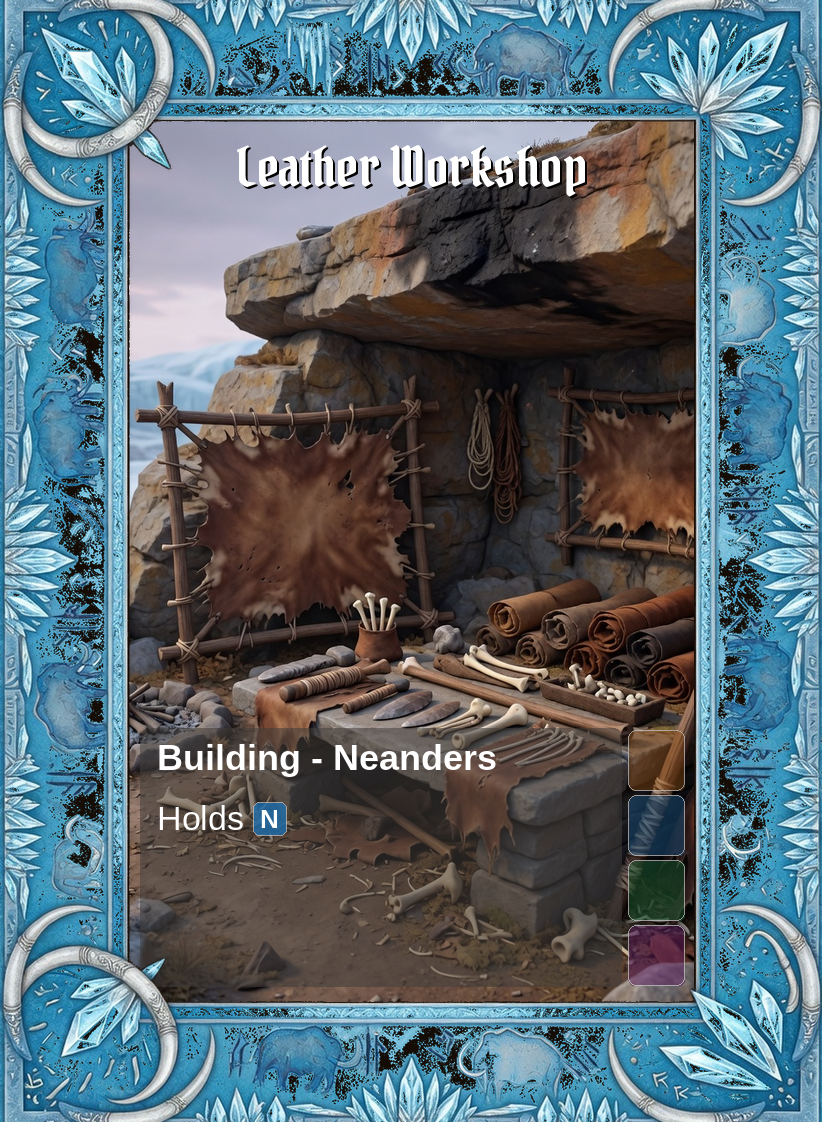
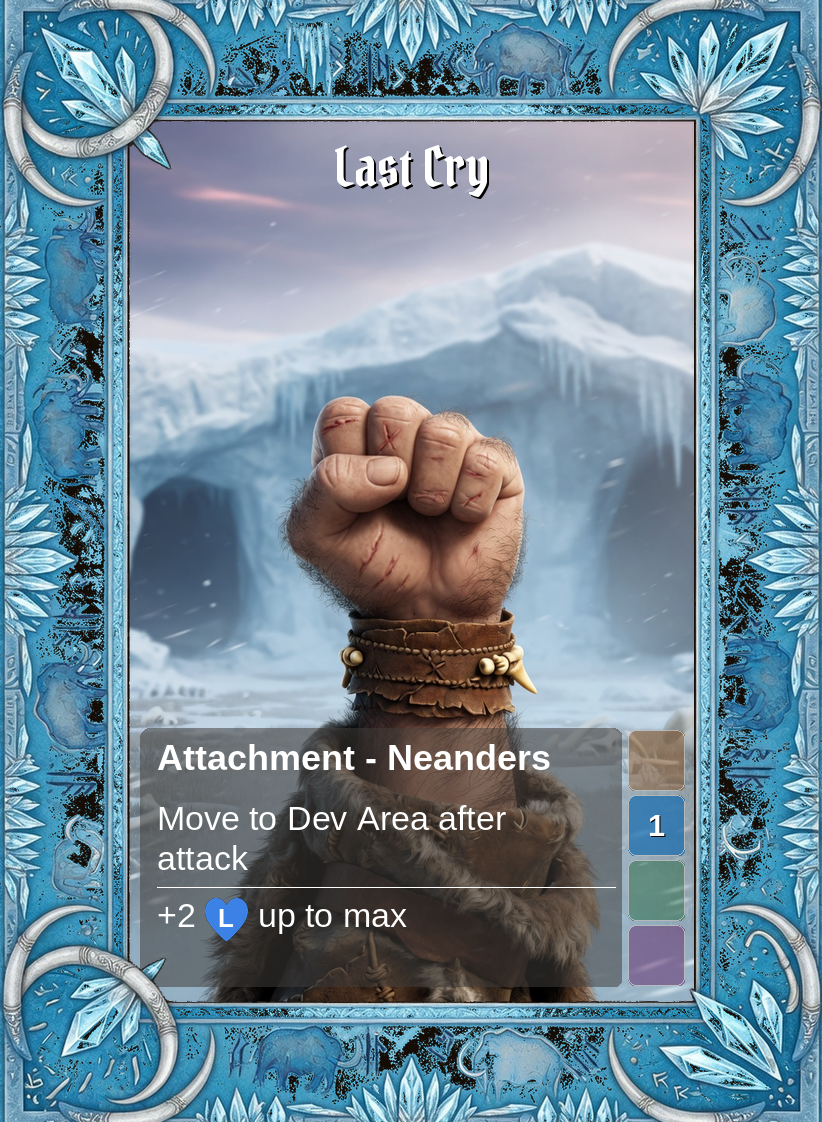
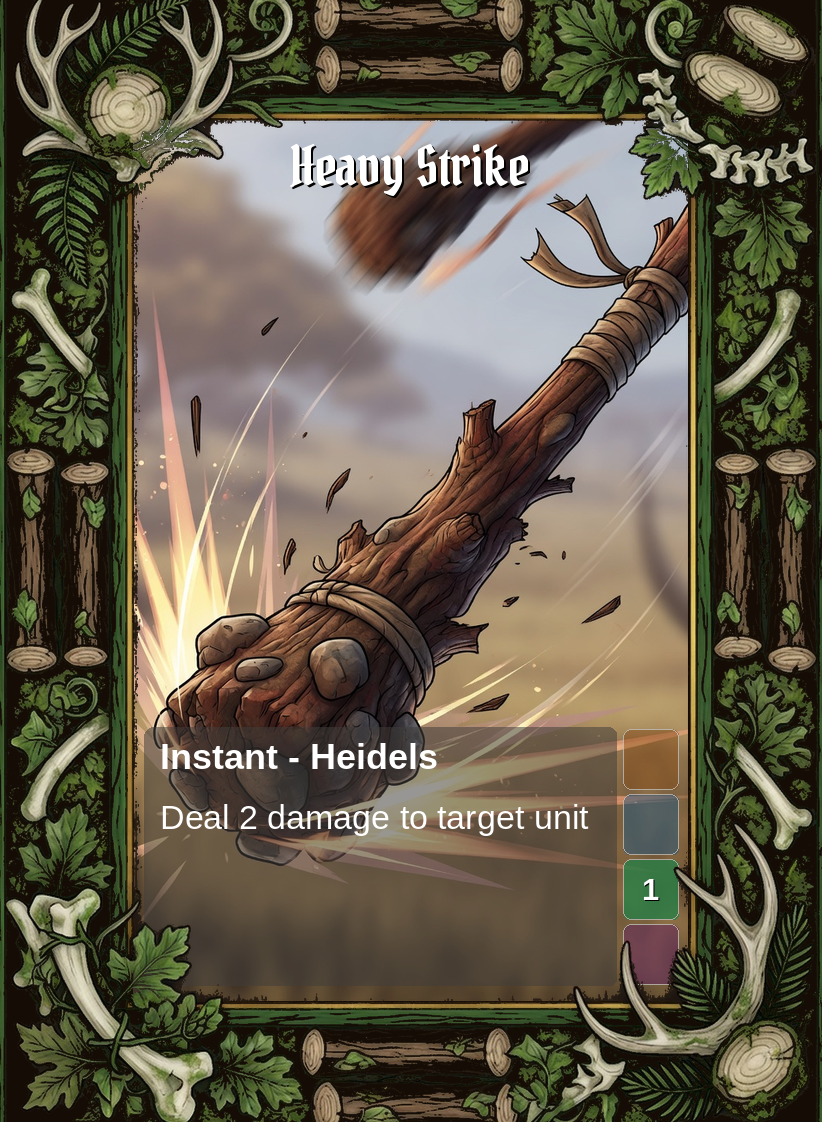
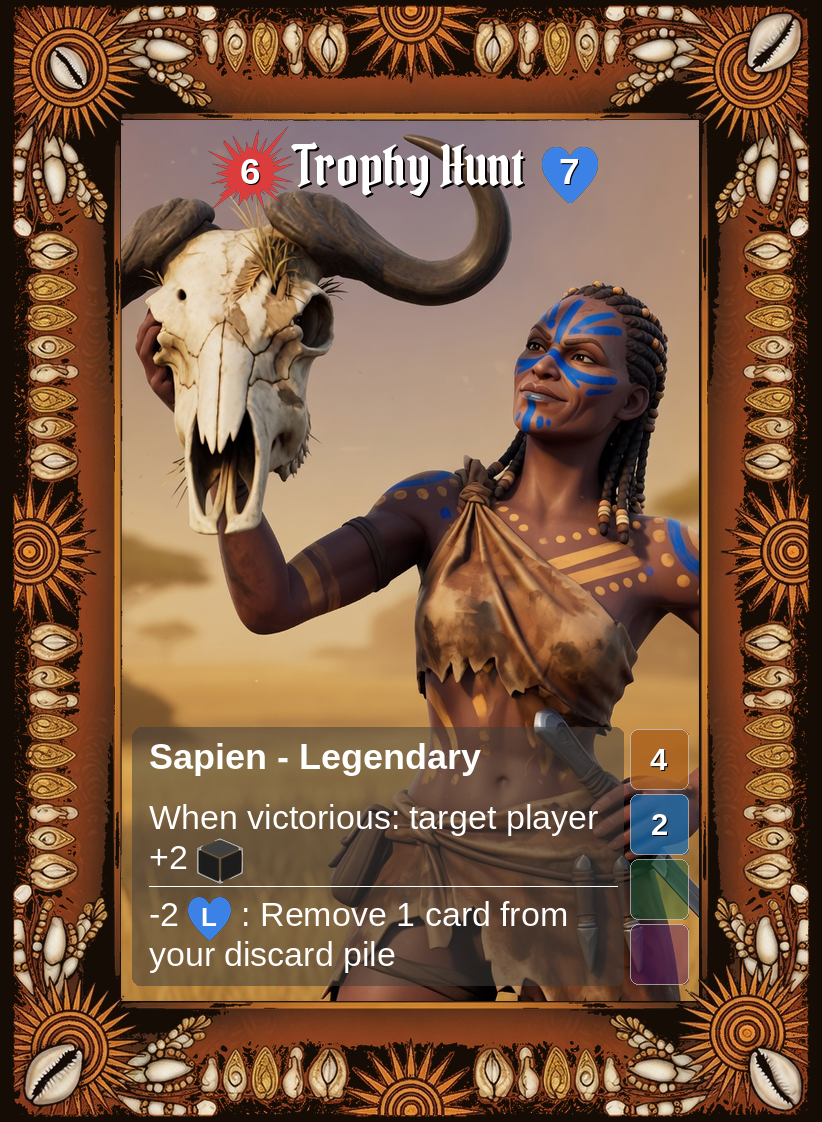
Units
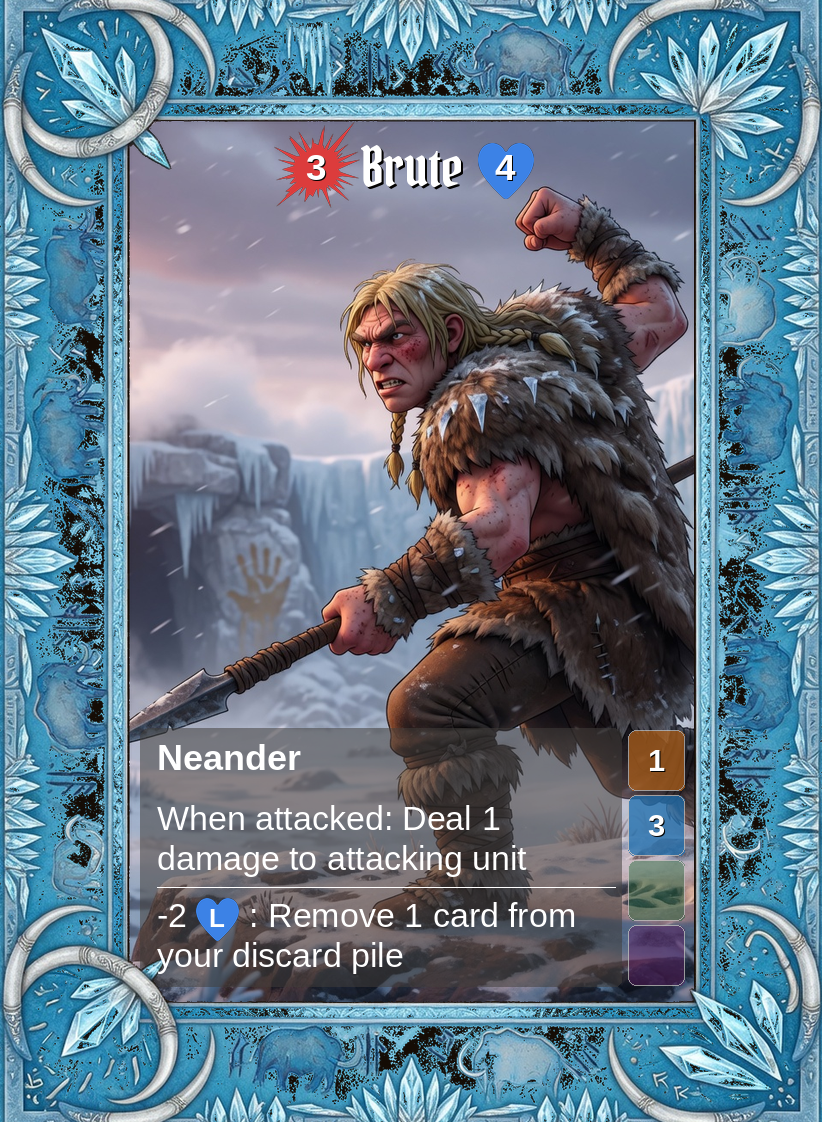
- Have Power (damage dealt) and Life. The printed values are the maximum values, but these can be altered by some card abilities.
- Can only attack and block while in the Combat Area.
Life Cubes
Unit life is tracked by blue cubes from the general supply. Player life is tracked separately with a Life-tracker device (starting at 20).
- When a unit moves to Combat Area, it keeps its current Life and Power cubes
- The printed unit Life value shows the capacity (unless a card ability changes it)
- In combat, a defending unit takes damage equal to the attacker's power cubes
- Zero life: when a unit's life reaches 0 (through damage, or by paying Life with a card ability), the unit is immediately discarded to the graveyard, together with its attachments. Its power cubes return next to the owner's buildings, as described under Resolve Destruction. Before the unit is discarded, any player may respond with an instant that prevents the loss of its last Life (see Instants)
- A player is eliminated directly when their Life-tracker reaches 0 (regardless of any unit life on the board). This is the only life total that matters for the victory/loss condition. Before the player is eliminated, any player may respond with an instant that prevents the elimination (see Instants)
- Development abilities can add life cubes to a unit (up to maximum); each cube comes from (and if lost, return to) the general supply
Buildings
- Contain resources (no maximum capacity), see Resources
- Always remain in the Development Area — cannot be moved to Combat Area.
- Hold resource cubes that any player may take (under some conditions, see Resources).
Attachments
- Can only attach to buildings or units in the Development Area: must be played while target is there.
- Move with the unit to Combat Area at the start of the Main Phase.
- Zone-specific abilities apply: Development ability active in Development Area, Combat ability active in Combat Area.
- Discarded when the unit is destroyed.
Instants
- Cost resources to play with no per-turn limit. It is allowed to obtain required resource(s) via 1 or more Workers (see Resources)
- Resolve immediately and go to the graveyard
- Action order = table order (first-played, first-resolved; no stack)
- Default first player in disputed timing: active player (or attacking player during combat)
- Response windows after completed actions — other players respond after action is fully declared, but before unit is actually discarded to the graveyard (if applicable). This allows to counteract an otherwise lethal action.
Card Anatomy
Every card shares the same visual layout. Understanding each zone helps you read cards at a glance.
| Zone | Location on card | Contents |
|---|---|---|
| Name | Top | The card's name |
| Power / Life | Top Left & Right | Power / Life capacity (units only). Power = damage dealt (shown with a black ★); Life = maximum life. |
| Resource cost | Bottom-right | The 4 stacked, square icons show the cost (per resource) for this card (to play it to the Development Area) |
| Art | Middle | Tribe artwork |
| Type line | Lower half | Card type (Unit / Building / Attachment / Instant), tribe name, and Legendary tag if applicable |
| Combat abilities | Text box — upper part | Activeonly while the card is on the Combat Area |
| Development abilities | Text box — lower part | Activeonly while the card is in the Development Area |
Combat and Development Abilities
A card's text box is split into two sections by a thin divider line:
- Combat (top half) — abilities that function only while the card is on the Combat Area. These abilities may only be activated during combat. Typical examples: attack triggers, passive power or life bonuses to your warband, blocking bonuses.
- Development (bottom half) — abilities that function only while the card is in the Development Area. These abilities may only be activated during your Main Phase. Typical examples: economic bonuses, hand manipulation, building synergies, and deck-control effects.
A card in the Development Area has no Combat abilities; a card on the Combat Area has no Development abilities. Only the abilities matching the card's current zone are active. This applies to all card types, including units and attachments.
Ability Usage: Every card ability can be executed only once per turn unless stated differently. When a card has multiple abilities, each individual ability can be executed once per turn.
Cards without text in one half have no ability in that zone. Cards without text have no abilities (other than their power and thoughness).
Units in the Development Area are placed in specific lanes (left, center, or right) that correspond to the lanes in the Combat Area. A unit's lane is determined when it is played and cannot be changed unless a card ability specifically allows it. This lane system ensures that units can only be targeted by attacks and abilities from the corresponding lane in the Combat Area, and life cubes can only be moved between units in the same lane during the Main Phase.
Combat
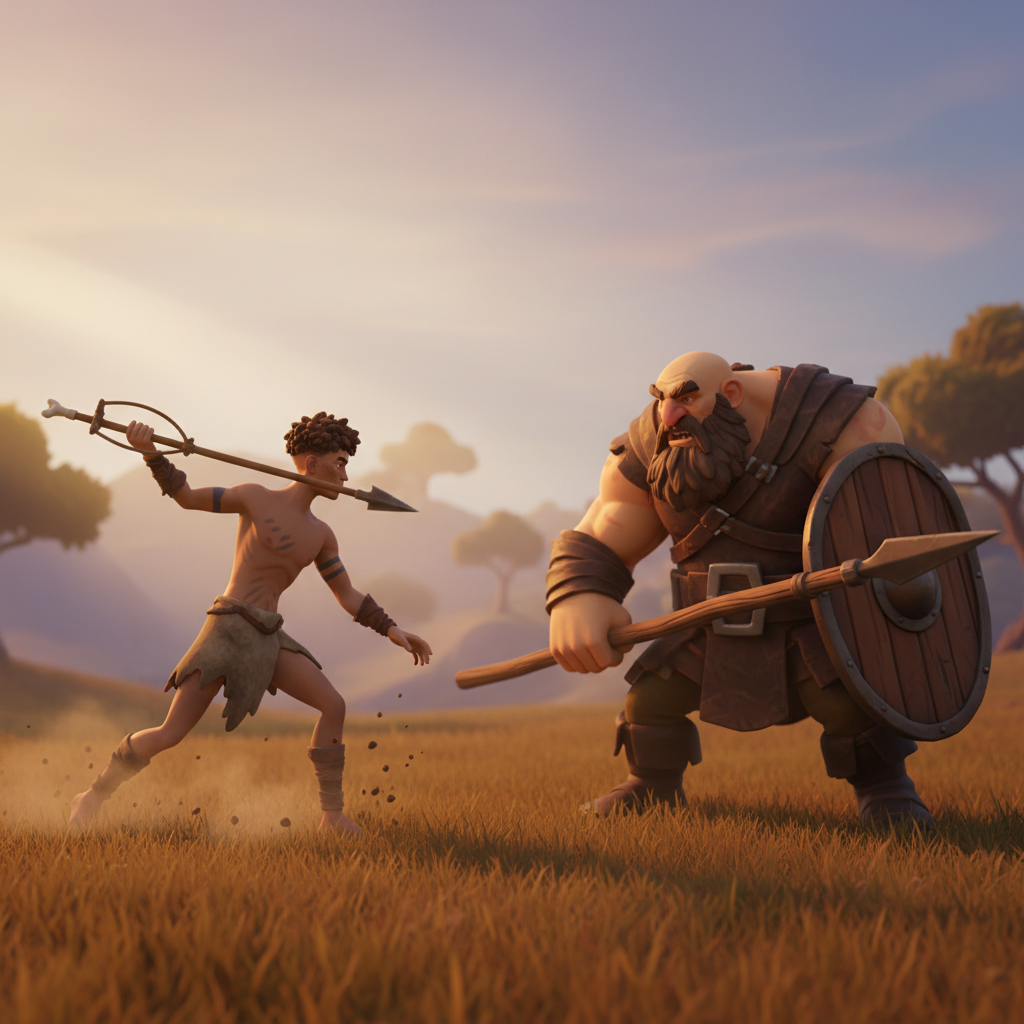
Overview
Only cards in player's Combat Area can defend and/or attack. Each unit can only attack once each Combat phase, unless an ability states otherwise. Combat is simultaneous — each attacker is paired 1-vs-1 (unless abilities state different) with one blocker based on lane positioning. Both units in a pair deal damage equal to their power cubes at the same time; either or both can be destroyed. Unblocked attackers deal their power directly to the defending player's Life — the defender moves that many blue life cubes from their personal supply to the general supply, unless they intercept the attacker with one of their own units (see Interception).
Step by Step
0. Start-of-Combat window (attacker first). Before attackers are declared, players may play instants. If timing is disputed, the attacking player acts first.
1. Declare Attackers. The active player announces which units in their Combat Area will attack by pushing them against the opponent's player card. Each unit may only attack once per turn. Tapped units cannot attack. Responses happen only after the full declaration is complete.
2. Lane-based blocking: a defending unit in the Combat Area, in the same lane position as an attacker may block that attacker. A unit may only block one attacker unless abilities state differently; each attacker may have at most one blocker unless abilities state differently. If the defender has no blocker available or chooses not to block, they may intercept (see Interception); otherwise the defending player moves blue life cubes equal to that attacker's power cubes from their personal supply to the general supply (besides their building).
3. Simultaneous Damage. In each pair, attacker and blocker deal damage equal to their power cubes simultaneously. A destroyed unit still deals its full power first. If the defender chose to block, the defending unit/player must absorb all damage from its paired attacker. For excess power beyond the blocker's life, the defending player moves blue life cubes equal to that attacker's excess power from their personal supply to the general supply (besides their building).
4. Resolve Destruction. Any unit that took damage ≥ its current life, or whose life is at 0, is destroyed and sent to the graveyard immediately (see Zero life under Life Cubes). Its blue life cubes return to the general supply. For each non-blocked attacker, the defending player moves blue life cubes equal to that attacker's power cubes from their personal supply to the general supply (besides their building).
5. Power Spent. After combat is fully resolved, blocking and intercepting units spend all their Power cubes, and unblocked attackers spend all their Power cubes. An attacker that fought a unit spends only as many Power cubes as that unit had Life before damage, up to the attacker's Power; any remaining Power stays on the attacker. Excess damage still applies to the defending player's Life as described above. Spent cubes are removed from the unit and placed next to their owner's buildings; they return to the buildings during that player's next End Phase. This happens whether or not the unit survives.
Interception
An unblocked attacker damages the defending player's Life. To save that Life, the defending player may intercept the attacker by stepping a unit in front of it. Interception is declared during step 2, after blockers have been assigned, and only for attackers that are still unblocked.
To intercept an attacker, move one of your units into that attacker's lane:
- a free unit in your Combat Area — a unit that is not yet assigned as a blocker against another attacker, or
- a unit in your Development Area — it moves to your Combat Area in that lane, directly in front of the attacker.
The intercepting unit then fights the attacker exactly like a declared blocker: both deal damage equal to their power cubes simultaneously, and the attacker deals no damage to your Life. Excess power beyond the intercepting unit's life is lost.
- Interception is optional, and it protects only the attacker it is made against — every other unblocked attacker still costs you Life.
- A unit may intercept one attacker only, and a unit already blocking cannot intercept again.
- A Development Area unit that intercepts is now in the Combat Area and stays there; it can be attacked and destroyed normally.
- Interception uses the same lane as the attacker unless a card ability states otherwise.
Combat Example
Player A attacks with a Mammoth Guard (4/4); Player B blocks with a Cub (2/1).
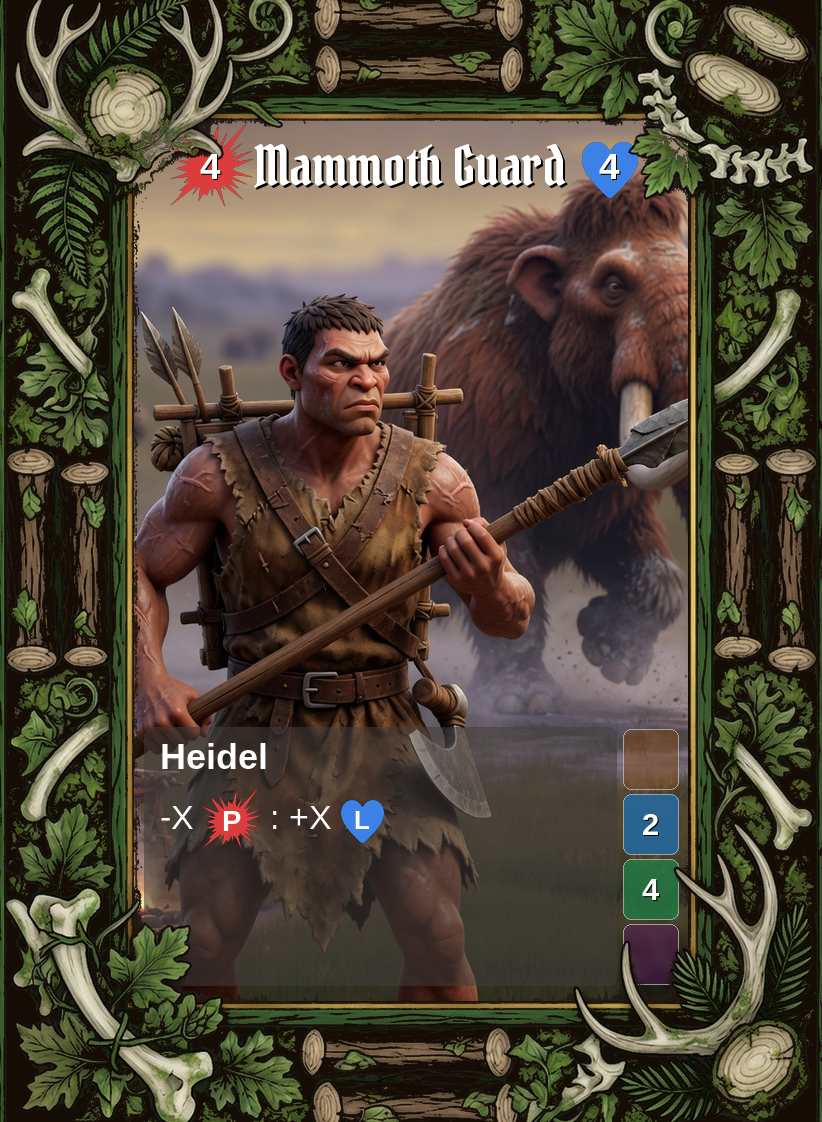
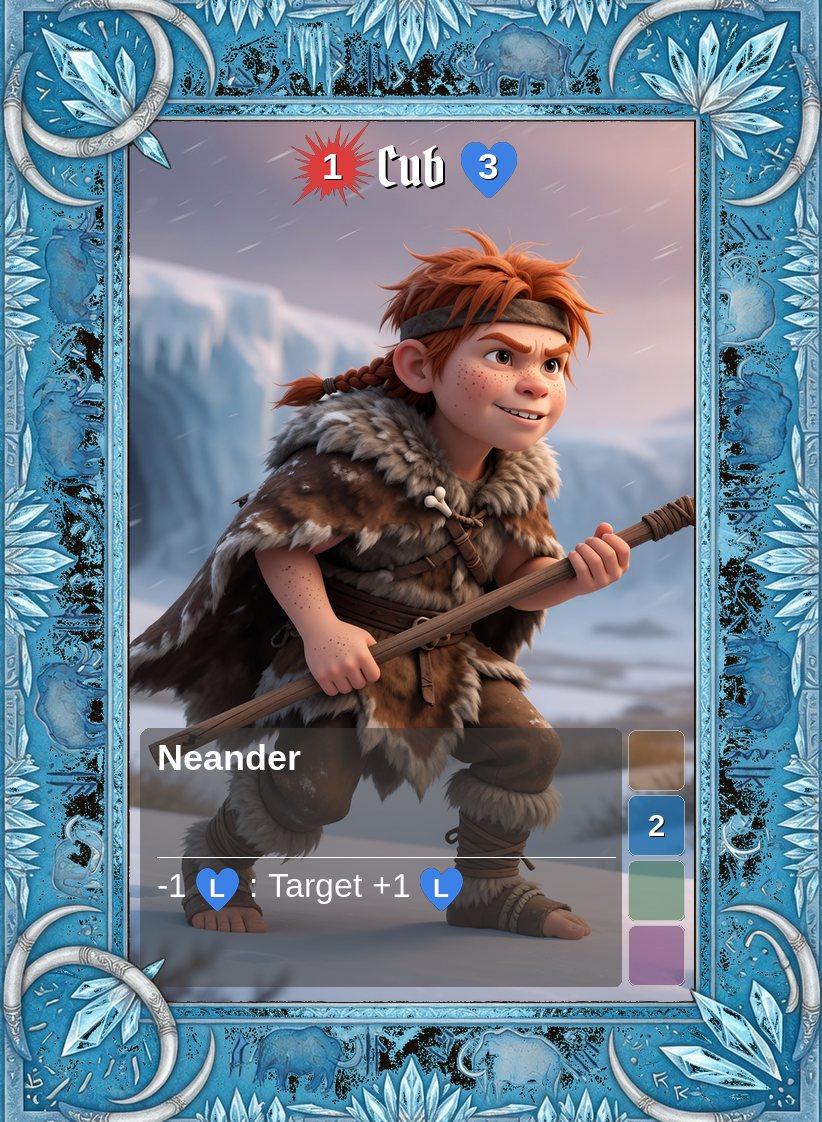
Simultaneous exchange: Mammoth Guard deals 4 power to Cub (→ destroyed, life cubes return to general supply); Cub deals 2 power to Mammoth Guard (life 4 → 2, survives). After combat, both units' Power cubes are spent beside their owners' buildings until each owner's next End Phase. Player B's Life is untouched — the attacker was blocked.
Key rule: Both sides deal damage simultaneously. A blocked attacker never reaches the player's Life; excess Power beyond the blocker's life is lost.
Interception example: Player A's Mammoth Guard (4/4) is left unblocked and would cost Player B 4 Life. Instead Player B moves their Development Area Gatherer (1/2) in front of it. The Mammoth Guard deals 4 power, destroying the Gatherer, and takes 1 power in return (life 4 → 3). Player B's Life is untouched.
See Victory Conditions for elimination rules.
Card descriptions
Targeting Rule
Units in the Development Area cannot be targeted by abilities or instants (except abilities that explicitly target Development Area units). Only Combat Area units and Development Area buildings may be targeted.
Definitions
Generic:
- In below table, if 'X' is a number then maximum that amount can be transferred per turn
| Keyword | Effect |
|---|---|
| +X/-X Power | Only applies this turn (is not cumulative), unless the ability specifies otherwise. Not restricted by unit Power capacity. Does not require building resources. If ability is per unit (e.g., "+X Power per Combat Heidel"), then it includes itself |
| +X Life | Moves Life from general supply to unit. Cannot move more Life than unit's life capacity allows |
| -X Life | Moves Life from unit to general supply |
| +X H/D/S/N | Moves resource(s) from your building(s) to unit, unless the ability specifies otherwise. Cannot move more resources than unit's Power capacity allows |
| -X H/D/S/N | Moves resource(s) from unit next to your building, unless the ability specifies otherwise |
| Place: | Move one or more of your possessions as specified (e.g., resource in your personal supply, card in your hand). "Place 1 resource/power" means place one black resource or power cube from your personal supply. |
| Target: | Any card in play (either in Combat Area or Development Area) |
| On play: | The effect triggers the moment the card is played from hand to your Development Area (for Development Abilities) or the moment the card is played from Development Area to Combat Area (for Combat Abilities). |
| Pronoun convention ("yours", "your") | When an ability references a location using a possessive pronoun (e.g., "swap resource on opponent building withyours"), the pronoun always refers to the same location type but belonging to the player who plays the card. Example: "swap resource on opponent building with yours" means to swap a resource on an opponent's building with a resource on one of your own buildings. |
| Capacity: N [resource] | Printed on buildings only. The building auto-refills up to this capacity at end of turn. |
| Turn start: | The effect triggers at the start of your Draw Phase (before you draw your 3 cards) |
| End phase: | The effect triggers at the end of your turn (during your End Phase). Always refers to your own end phase unless otherwise specified. |
| Discard: | The effect triggers when the user discards this card to the graveyard |
| Draw: | Take the top card(s) of your Deck into your hand. If your Deck is empty, shuffle your Discard pile into your Deck first, then draw. Cards an ability draws always come from your Deck unless the ability names another pile. |
| Keep X: | Keep up to X cards as instructed by an ability. Unless the ability specifies another destination, put the kept cards face-down on top of your Discard pile. |
| Deck / Discard pile: | Your own two face-down piles (see Deck & Discard pile). No opponent may look at or search them unless an ability names them. |
| Intercept: | Move a free unit of your Combat Area, or a unit of your Development Area, into the lane of an unblocked attacker so it fights the attacker instead of you losing Life (see Interception). |
| When victorious: | The effect triggers when this unit/card killed/destroyed another unit, attachment or instant AND it was not killed/destroyed itself. Holds either when this unit/card attacked or was attacked. |
| Before/After attack: | The effect triggers before/after this unit/card attacks/attacked. The effect triggers regardless of the Combat outcome (also triggers when this unit is destroyed) |
| When attacked: | The effect triggers when this unit/card is being attacked by another unit or instant. |
| When killed / When destroyed | The effect triggers when the card is destroyed (in combat or by an ability) and sent to the graveyard. |
| When attached is destroyed | The effect triggers when the unit the attachment is on is destroyed. |
| Returns to hand | Instead of going to the graveyard, the card goes back to its owner's hand. |
| Prevent N damage per attacking unit | Reduces incoming combat damage by N for each individual attacker. |
| When blocking: enemy units −1 power | While this card is assigned as a blocker, each attacking unit has its power reduced by 1 for this combat. |
| Control target | Take control of a target unit (yours or an opponent's) until end of turn. The controlled unit may attack or block for you this turn. |
| Rearrange top N main pile cards | Look at the top N cards of the main pile. Rearrange them in any order and return them to the top. You do not draw these cards. |
| Resurrect | Take a card from the graveyard and place it directlyin your hand. Ancestral Memory specifies "the last 3 cards" — look at the top 3 and pick 1. |
| Place N [resource] / −1 per attack / discard at 0 | The card enters with N resource counters. It loses 1 counter each time it attacks. When the last counter is removed, the card is immediately discarded. Counters count as resources in your supply and can be spent normally. |
| Variable Power (?, 0, or X) | Some cards have Power that changes based on the card's condition.? means Power is calculated by a card ability (see card text). 0 means the card enters with 0 Power but may gain counters during play (e.g., Avalanche Strike). X means Power is set by a card ability (e.g., Elite Hunter). In combat, use the card's current Power value at time of damage. |
| Empty: [building ability] | Some buildings carry an Empty: line that describes an ability usable while the building has cubes. (Buildings auto-refill to minimum 2 resources at end of turn — see Building Refill.) |
| "Card" reference | When an ability refers to a**"card"** without further qualification, it refers to a card in hand unless the ability specifies a different zone (e.g., "card from graveyard", "card from Development Area"). |
| Peek | Look at the target location without revealing to other players. Return card(s) to the specified location in the same order. You may rearrange if the ability specifies rearrangement. Can only be executed once per turn |
| Pay [cost] | Spend the described cost by moving the specified amount of the specified resources from your building to a location next to your building |
| **Empty target ** | Move all resources from specified target next to target owner's building |
| Remove N [resource] | Take N power/resources from the specified unit/building and move them next to the owner's building |
| Adding resources: source is always controller's supply | When an ability states to add resources to a target, those resources are always drawn from the player who controls the ability card (not from the target player or an opponent), even if the ability is triggered by an opponent's action. Resource generation abilities (e.g., "-1 Life: +1 resource") place resources in the controller's personal supply (not directly on buildings). |
| Lane: | Units are placed in specific lanes (left, center, or right) when played. A unit's lane is determined when it is played and cannot be changed unless a card ability specifically allows it. This lane system ensures that units can only be targeted by attacks and abilities from the corresponding lane in the Combat Area, and life cubes can only be moved between units in the same lane during the Main Phase. |
| Move Life: | During the Main Phase, you may move blue life cubes between units in your Development Area and Combat Area, but only within the same lane (left, center, or right) unless a card ability states otherwise. This allows you to reinforce key units or transfer life from less important units. |
Discard means placing the card(s) face-down on the shared graveyard. Cards an ability discards from your hand go to the graveyard; your Draw Phase discard choice and cards kept by an End Phase or card ability go to your own Discard pile.
Victory Conditions

There are three paths to victory — you win the instant you achieve any one:
- Domination (combat): be the last player/team standing (reduce every opponent to 0 Life).
- Prosperity (development): accumulate superior resources — control 2x more resource cubes than your opponent(s) in your personal supply and/or on your buildings combined (see Prosperity Victory).
- Legacy (legendary): control 3 Legendary units at the end of your turn. In 4P games the team must control 6 Legendary units in total at the end of one of their turns.
Free-for-All (2–3 Players)
A player's Life is tracked by their Life-tracker device (starting at 20). Unit life is funded from the general supply and does not affect a player's personal life. Reduce an opponent's Life-tracker to 0 to eliminate them. The last surviving player wins.
Team Mode (4 Players)
When any player on a team has their Life-tracker reduced to 0, their entire team is immediately eliminated. The surviving team wins.
Prosperity Victory (Development Path)
A tribe can also win without eliminating anyone by building a superior economy — accumulating more resources than opponents.
You win immediately if, at the start of your Main Phase, after promotion and power loading, you (in 2P/3P) or your team (in 4P) controls 2x more resource cubes than your opponent(s) on your buildings and/or in your personal supply combined. Resources in the general supply do not count.
Legacy Victory (Legendary Path)
A tribe can win by assembling a legendary warband — proving their species' dominance through the greatest champions of the age.
You win immediately if, at the end of your turn, you control 3 or more Legendary units (or in 4P your team controls 6 or more Legendary units) across your Development Area and Combat Area combined. Legendaries must be in play (not in hand, graveyard, or one of your personal piles)
Playing Tips
- Select low-cost cards in the early game. Your buildings hold only a few cubes at the start, so cards costing 1–2 are the only ones you can pay for. Playing them early builds your board and your economy before the bigger cards become affordable.
- Generate resources early, even at the cost of a card. Cards that let you pay Life for resources (e.g. "-2 Life: +1 resource") effectively cost you the unit's remaining life, and a unit used this way is often lost. Still, the extra resources in the early game make your position stronger: you can afford more cards every turn from then on.
Edge Cases
This section codifies rulings for situations the core rules do not explicitly cover.
Combat
- Tied life at simultaneous 4P teammate kills. If overflow combat damage reduces players on both teams to 0 Life simultaneously, both teams lose; the game is a draw.
- Interception with an empty lane. A Development Area unit may intercept into any lane that holds an unblocked attacker, but only one unit per attacker; two attackers in the same lane can never be intercepted by a single unit.
Deck & Draws
- Both personal piles empty at Draw Phase. Shuffle your Discard pile into your Deck; if both are empty, you simply draw nothing.
- Main pile exhausted at End Phase. Shuffle the graveyard into a new main pile and keep drawing (see Main pile reshuffle). Only if both piles are empty do you draw what is left. The End Phase keep-up-to-3 choice still happens.
- Worker bonus draws. Extra draws from worker cards are drawn together with the 5 cards of the End Phase draw; they are part of the same pool you choose up to 3 cards from.
- War Paint "Returns to Development Area when killed". When a unit with War Paint is destroyed, War Paint returns the unit face-down to the controller's Development Area. The unit enters that player's Discard pile in their next End Phase. If the unit and the attached card belong to different players (e.g. after a control swap), follow the wording on the printed card.
- Zero-life response window. A unit reduced to 0 Life is not discarded until the other players have had a chance to respond with an instant that prevents the loss of its last Life. If such an instant resolves, the unit is not discarded and stays in play. Otherwise the discard happens immediately.
- Wayfinder with < 3 cards in main pile. Rearrange whatever is there (1 or 2 cards is fine; effect does not fizzle).
Instants & Timing
- No stack. Instants resolve in the order they are declared and placed (first-played, first-resolved). In ties or unclear timing windows, use the default first-player rule: active player first, and attacker first during combat declarations.
4-Player Team Mode
- Helpful effects on teammates are allowed. Buffs, heals, and similar "target" effects may target your teammate or their cards.
- "Opponent" excludes teammates. For every rule and ability — including Trade Warden — your teammate is never an opponent.